For dealers and buyers11 min read
Buying a used car: a checklist for documents, inspection and contract
- Author
- Luka Velkavrh
- Edited by
- WeltScout editorial team
- Published
- Updated
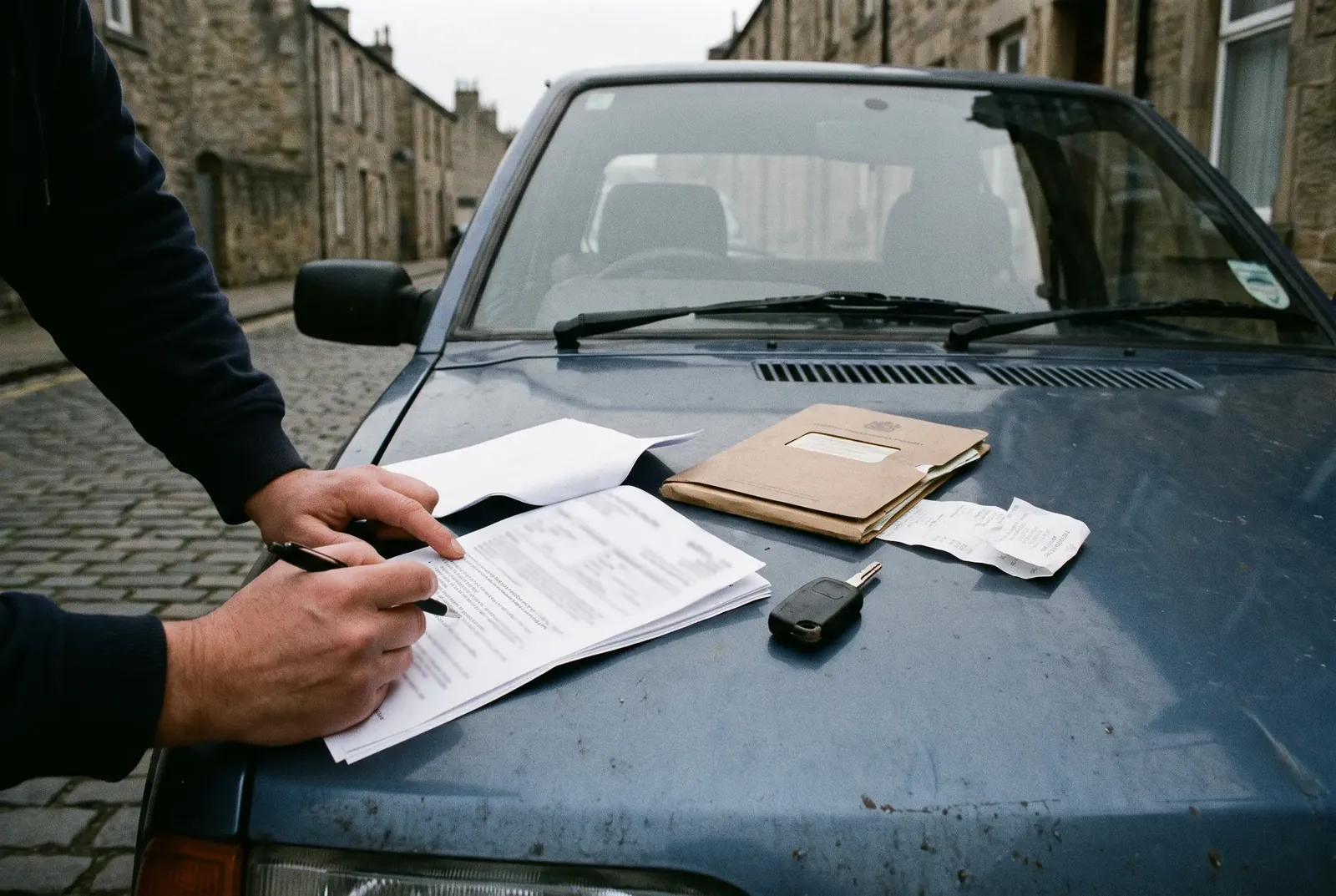
In short
Before you pay, check in this order: the listing and the seller, the documents, the car itself (inspection and test drive), and the contract. This guide is for private buyers and for dealers who buy cars to resell. It covers purchases in the EU, with Slovenia, Croatia and Germany as examples; UK rules differ. As of October 2026.
Contents
- A five-step checklist
- The listing and the seller: what to check before you travel
- Documents: what the seller must show
- Inspection and test drive
- The contract: what it should state
- Guarantees and liability: dealer or private seller
- After the purchase: transfer and registration
- What this means for a buyer and for a dealer
- Official sources and calculators
- Frequently asked questions
- Sources
- Updates
A five-step checklist
Before you pay, check five things in this order: the listing and the seller, the documents, the car itself, the test drive, and the contract with the payment. The order matters because each step finds something that would cost you money at the next one. For each step the table shows what you check, what you ask for and when to walk away.
| Step | What you check | What you ask for | Walk away if |
|---|---|---|---|
| 1. Listing and seller | Private seller or dealer, where the car is, whether the description matches the photos | Photos of the registration certificate and of the car, with the chassis number visible | The seller will not show documents or avoids questions |
| 2. Documents | Name on the registration certificate, chassis number (VIN), vehicle data | Original documents, the seller's ID | The seller's name differs from the one on the document, or the numbers do not match |
| 3. Inspection | Bodywork, tyres, underbody, engine, electrics | The service book or invoices, ideally an inspection by an independent mechanic | Signs of repair that the seller did not mention |
| 4. Test drive | Braking, steering, gearbox, warning lights | A cold start | The engine is already warm when you arrive and the seller does not explain why |
| 5. Contract and payment | Both parties, the car, the price, its condition | A written contract and proof of payment | The seller wants cash and no written contract |
The listing and the seller: what to check before you travel
You can spot most problems before the viewing if you ask the seller for photos of the registration certificate and the chassis number. Also ask whether the seller is a private person or a dealer (your rights depend on it), compare the price with several similar listings, and check that the photos show the same car and that the location matches the seller.
- Ask whether the seller is a private person or a dealer. Your rights after the purchase depend on it (see the section on guarantees).
- Compare the price with several similar listings. A price clearly below comparable cars needs an explanation.
- Check that the photos show the same car and that the listing gives the same location as the seller does.
- Arrange the viewing at the seller's address and in daylight.
Documents: what the seller must show
The seller should be able to hand over all the documents you need to register the car, and the originals (Your Europe, read on 19 October 2026). These are the registration certificate with all its parts, the seller's ID with the same name as on the certificate, proof of a valid roadworthiness test and, ideally, the service book. The chassis number must be the same on the document and on the car.
- Registration certificate. It may come in one or two parts. If there are two, you need both when you re-register the car in another EU country (Your Europe, read on 19 October 2026).
- The seller's ID. The name must match the registration certificate. If someone else sells the car, ask for a written authorisation.
- Chassis number (VIN). Compare it on the document and on the car. If they differ, do not buy.
- Proof of a valid roadworthiness test. Check the date it runs to.
- Service book and invoices. They show whether maintenance was done, and when.
- A question about liens. Ask whether the car is financed or leased, and get written confirmation that it is free of encumbrances.
Inspection and test drive
An inspection works best with a fixed list of seven points: bodywork, tyres, leaks under the car and under the bonnet, a cold start, the electrics, a test drive that checks braking, steering and gearbox, and a comparison of the mileage with the wear and the service book. The list does not replace an inspection by a mechanic.
- Look at the bodywork in different light. Uneven gaps between panels and a different shade of paint point to a repair.
- Check the tyres. Uneven wear on one side can mean a suspension or alignment problem.
- Look under the car and under the bonnet for oil, coolant or fuel leaks.
- Start the engine cold. Watch for smoke, listen for unusual noise and note any warning lights.
- Try everything electrical: windows, lights, air conditioning, seat heating.
- On the test drive, check braking, steering and the gearbox. The car should not pull to one side.
- Compare the mileage with the wear on the steering wheel, pedals and seat, and with the entries in the service book.
This list does not replace an inspection by a mechanic. If the car is far away or in another country, an independent inspection is worth even more.
The contract: what it should state
A written contract should contain the details of both parties, the car (make, model, chassis number, date of first registration, mileage at handover), the price and payment method, known defects and damage, extras that come with the car, and the date and place of handover with both signatures. Country rules on proof differ, as the two notes below show.
- Name, address and ID number of the seller and the buyer.
- Make, model, chassis number, date of first registration and mileage at handover.
- The price and the payment method. A bank transfer is better than cash because it leaves a record.
- Known defects and damage. What is written down cannot easily be disputed later.
- Extras that come with the car: the number of keys, the service book, winter tyres.
- Date and place of handover, and the signatures of both parties.
In Croatia the seller's signature on the contract does not need to be certified by a notary (Porezna uprava, read on 19 October 2026). In Germany the registration office accepts a purchase contract or other proof of the right to dispose of the car (BayernPortal, read on 19 October 2026).
Guarantees and liability: dealer or private seller
You are better protected when you buy from a dealer than from a private person, because EU consumer rights do not apply to private sales (Your Europe, read on 19 October 2026). From a dealer, the legal guarantee under EU rules is at least two years.
For used vehicles it can be shortened in some EU countries to no less than one year, but the buyer and seller must agree to that at the time of purchase (Your Europe, read on 19 October 2026). In Germany a private seller can exclude liability for defects, but cannot rely on that exclusion if the defect was fraudulently concealed or a guarantee for the condition was given (§ 444 BGB, read on 19 October 2026). If the seller promises something, for example a working air conditioning, get it into the contract in writing.
After the purchase: transfer and registration
In Slovenia the owner must report the change to the registration organisation within 15 days (gov.si, read on 19 October 2026). In Croatia the new owner must register the vehicle, or deregister it, within 15 days of acquiring it (Pravilnik o registraciji i označavanju vozila, read on 19 October 2026). Germany works differently. The three notes below give each country's steps.
- Slovenia: the owner must report the change to the registration organisation within 15 days and attach proof of the change, such as a sales contract or an invoice (gov.si, news item of 6 February 2024, read on 19 October 2026).
- Croatia: the new owner must register the vehicle in his or her name, or deregister it, within 15 days of acquiring it (Pravilnik o registraciji i označavanju vozila, Article 48(1), NN 130/2017, original text read on 19 October 2026; we did not check later amendments). After signing the contract the buyer goes to a vehicle inspection station, where the administrative fee is calculated; without proof of payment the vehicle cannot be registered (Porezna uprava, read on 19 October 2026).
- Germany: the registration office asks for both parts of the registration certificate, an ID, the vehicle's inspection report, confirmation of liability insurance (eVB) and the plates, and in some cases a power of attorney or an expert report (BayernPortal, read on 19 October 2026). This section describes Germany only; Austria uses a different procedure.
We do not quote any fees or taxes here. For a car from another country, the country where you register it may ask for extra documents, such as proof that VAT was paid (Your Europe, read on 19 October 2026).
What this means for a buyer and for a dealer
For a private buyer
Use the checklist above on every car, even if the seller seems trustworthy. If you are unsure about the condition, pay for an independent inspection before you sign. WeltScout is built for dealers and brokers, so as a private buyer you search the portals directly.
For a dealer
If you buy cars to resell, use the same list for every car and keep the evidence with the vehicle: photos of the documents, the inspection notes and the contract. That lets you show your own customer what you checked. When you look for cars, WeltScout saves you the repeated browsing: you set up a search once and we send new listings to your WhatsApp or e-mail. We cover 50+ portals in 14 countries and check for new listings once or twice a day, depending on the plan. The trial needs no card, and the Business plan costs from €129.90 a month excluding VAT. WeltScout does not inspect cars or check their history, so you still do the inspection and the documents yourself. More on the home page.
Official sources and calculators
We do not quote tax, fee or duty amounts in this guide; for amounts, use the official sources. We read seven, each on 19 October 2026: two pages of Your Europe, gov.si for Slovenia, the Narodne novine rules and Porezna uprava for Croatia, and BayernPortal and § 444 BGB for Germany.
- Your Europe: buying and leasing a car in another EU country
- Your Europe: car registration documents and formalities
- gov.si (Slovenia): transfer of ownership when a vehicle is sold
- Narodne novine (Croatia): rules on vehicle registration, NN 130/2017
- Porezna uprava (Croatia): buyer of a used motor vehicle
- BayernPortal (Germany): re-registration after a change of keeper
- gesetze-im-internet.de (Germany): § 444 BGB
This is not tax or legal advice. For a specific contract, talk to a tax adviser or a lawyer.
Frequently asked questions
How long do I have to register a used car in my name after buying it?
In Slovenia and Croatia it is 15 days (gov.si and Pravilnik NN 130/2017, read on 19 October 2026). In Germany the deadline is not stated in the source we read, so ask your registration office.
Do I need a notary for the purchase contract?
In Croatia the seller's signature does not need to be certified by a notary (Porezna uprava, read on 19 October 2026). For Slovenia we could not confirm a notary requirement from the sources we read, and for Germany the source says a purchase contract can serve as proof when proof of the right to dispose of the car is needed.
Do I get a guarantee when I buy from a private seller?
EU consumer rights do not apply to private sales, so be especially careful (Your Europe, read on 19 October 2026). Get anything the seller promises into the written contract.
Which documents must I see before I pay?
The registration certificate with all its parts, the seller's ID, proof of a valid roadworthiness test and, if possible, the service book. The chassis number in the document must match the one on the car.
Is the procedure different if I buy from abroad?
Yes. The country where you register the car may ask for extra documents, such as proof that VAT was paid (Your Europe, read on 19 October 2026). Check them before you buy. More on the blog.
Sources
- Buying and leasing a car in another EU country Your Europe, European Commission,
- Car registration documents and formalities Your Europe, European Commission,
- Pri prodaji vozila je treba urediti tudi prenos lastništva novemu lastniku (Slovenia) gov.si,
- Pravilnik o registraciji i označavanju vozila, NN 130/2017 (Croatia) Narodne novine,
- Kupac u tuzemstvu rabljenog motornog vozila (Croatia) Porezna uprava,
- Kraftfahrzeug; Beantragung der Umschreibung oder Wiederzulassung (Germany) BayernPortal,
- § 444 BGB Haftungsausschluss (Germany) Bundesministerium der Justiz, gesetze-im-internet.de,
Updates
- : Moved from the old site and rewritten to the new standard.
- : Each section now opens with a complete answer with facts and sources. The content of the sections is unchanged.
Searching several portals at once?
7 days freeNo card needed
Read next
For dealers and buyers7 min read
Buy a used car from Germany and import it to Serbia: customs, VAT, Euro 3
What you pay and which papers you need to bring a used car from Germany to Serbia: customs duty, VAT, Euro 3 and registration. Official sources read 28 October 2026.
For dealers and buyers5 min read
Buy a used car from Germany and import it to Slovenia: tax, plates, registration
What you pay and which papers you need to bring a used car from Germany to Slovenia: VAT, DMV, plates, conformity and registration. Sources read 28 October 2026.
For dealers and buyers5 min read
Buy a used car from Germany and import it to Croatia: PPMV, VAT, plates
What you pay and which papers you need to bring a used car from Germany to Croatia: PPMV, VAT, plates and registration. Official sources read 28 October 2026.