For dealers6 min read
Do you resell or import cars? A sourcing routine for dealers
- Author
- Luka Velkavrh
- Edited by
- WeltScout editorial team
- Published
- Updated
In short
You find better stock when you fix your buying criteria in writing, watch the markets that matter on a schedule, and settle the questions on VAT, registration and paperwork before you bid. This guide is for dealers and brokers who resell locally or import from other countries. It gives no tax or duty amounts. As of October 2026.
Contents
- Start with a written buying profile
- Domestic or abroad: what changes before you bid
- A sourcing routine you can repeat
- What to clarify before you bid on a car from abroad
- How monitoring with alerts changes the routine
- Official sources and calculators
- What this means for a dealer
- Frequently asked questions
- Sources
- Updates
Start with a written buying profile
A buying profile, with one sheet per customer or per stock target, decides what you look for before you start browsing.
- Make, model and generation, and which versions you will not take.
- Year and mileage range.
- The highest purchase price at which you still make your margin. Work it out from your own costs and margin.
- Must-have equipment, fuel type and gearbox.
- Seller type: dealer or private. It affects VAT and the paperwork (see below).
- Markets: which countries you are willing to buy in.
- Whether you accept damaged cars, and how far you will transport one.
Domestic or abroad: what changes before you bid
Buying abroad adds questions you must answer before you bid. The basic checks on the car stay the same.
| Question | Domestic purchase | Purchase abroad |
|---|---|---|
| Viewing | You go yourself, usually the same day | Travel, or an independent inspection arranged in advance |
| Documents | National documents you know | You need the originals, and the country where you register the car can ask for more (Your Europe, read on 19 October 2026) |
| VAT | National rules apply, so ask your accountant | A dealer may or may not charge VAT, depending on how the dealer calculates it (Your Europe, read on 19 October 2026). The page describes private buyers, so ask your accountant how it applies to your company |
| Taxes and registration | One set of national rules | Each EU country determines its own car taxes (Your Europe, read on 19 October 2026) |
| Transport | Usually short and simple to arrange | A separate cost and a separate risk to plan |
A sourcing routine you can repeat
A routine works when every step has an owner and an output, so nothing depends on who happened to browse that day.
| When | Task | Output |
|---|---|---|
| Once, when you take a customer's request | Fill in the buying profile and save the search | A search linked to the customer |
| After every alert | Decide in the same session: reject, ask the seller for documents, or call | A short list of cars worth a call |
| Before you bid | Run the list below on VAT, documents and registration | A yes or a no with a reason |
| Once a week | Compare your profiles with what customers actually ask for, and adjust filters | Updated searches, fewer irrelevant alerts |
What to clarify before you bid on a car from abroad
Settle these seven points before you bid, because a missing answer on any of them can turn a good price into a bad deal.
- Is the seller a dealer or a private person? The VAT treatment differs (Your Europe, read on 19 October 2026).
- Will the invoice show VAT separately or not? Ask in writing before you travel.
- Does the seller hold the original registration certificate, with all its parts? Your Europe says you should be able to get all the documents you need to register the car, in the original (read on 19 October 2026).
- What does the country where you will register the car require? It can ask for extra documents, such as proof of VAT payment (Your Europe, read on 19 October 2026).
- Who inspects the car, and when? Consider an independent inspection before you commit.
- How is the car transported, and who insures it on the way?
- Who is your buyer, and does your margin still work with the real costs?
How monitoring with alerts changes the routine
A saved search with alerts replaces repeated browsing with one setup and a short review after each alert.
| Manual browsing | Saved search with alerts | |
|---|---|---|
| Setup | You enter the same filters again on every portal | You set the search up once |
| Coverage | The portals you remember to open | The portals you selected, 50+ in 14 countries with WeltScout |
| Timing | When you find time to look | WeltScout checks once or twice a day, depending on the plan, and then sends the alert |
| Context | Browser tabs and notes | One list, with searches linked to customers |
WeltScout sends new listings to WhatsApp or by e-mail. In the Clients module you save each customer's name, e-mail, company and phone number and link searches to them, and a search can also be set up for your own stock. If a portal is missing, you can suggest it, and we usually add it within 4 to 7 working days. WeltScout finds and reports listings. It does not handle import paperwork, taxes or the inspection of the car.
Official sources and calculators
We give no tax, fee or duty amounts. The official pages we read on 19 October 2026 are:
- Your Europe: VAT when buying or selling a car abroad
- Your Europe: car taxes in another EU country
- Your Europe: car registration documents and formalities
- Your Europe: buying and leasing a car in another EU country
This is not tax advice. Your accountant or tax adviser decides how the rules apply to your company.
What this means for a dealer
The routine above works with any tool, even a spreadsheet and a browser. A tool pays off when you run several customer searches at once and want to see all of them in one place. WeltScout is built for that case. The trial needs no card, and the Business plan costs from €129.90 per user per month excluding VAT. More on the home page and in the blog.
Frequently asked questions
How often should I check for new listings?
As often as you can act on what you find. WeltScout checks once or twice a day, depending on the plan, so it fits routines where you review matches once or twice a day.
Do I pay VAT differently when I buy from a private seller abroad?
Your Europe says that a private person who buys from a private seller does not pay VAT in the seller's country and pays VAT only in the country where the car is registered (read on 19 October 2026). The page covers private buyers, so ask your accountant how it applies to your company.
Can I set up a search for my own stock?
Yes. A search does not have to be linked to a customer, and new listings reach you just as they do for customers.
Which portals does WeltScout cover?
50+ portals in 14 countries. You choose which of them each search watches.
Does WeltScout handle the import paperwork?
No. WeltScout finds listings and reports them. Taxes, registration and documents come from the official sources above and from your accountant.
Sources
- Value added tax (VAT) when buying or selling a car abroad Your Europe, European Commission,
- Car taxes in another EU country Your Europe, European Commission,
- Car registration documents and formalities Your Europe, European Commission,
- Buying and leasing a car in another EU country Your Europe, European Commission,
- WeltScout: used vehicle search for dealers WeltScout d.o.o.,
Updates
- : Moved from the old site and rewritten to the new standard.
Searching several portals at once?
7 days freeNo card needed
Read next
For dealers and buyers7 min read
Buy a used car from Germany and import it to Serbia: customs, VAT, Euro 3
What you pay and which papers you need to bring a used car from Germany to Serbia: customs duty, VAT, Euro 3 and registration. Official sources read 28 October 2026.
For dealers5 min read
One search, 11 portals: what an Audi A4 Avant returns
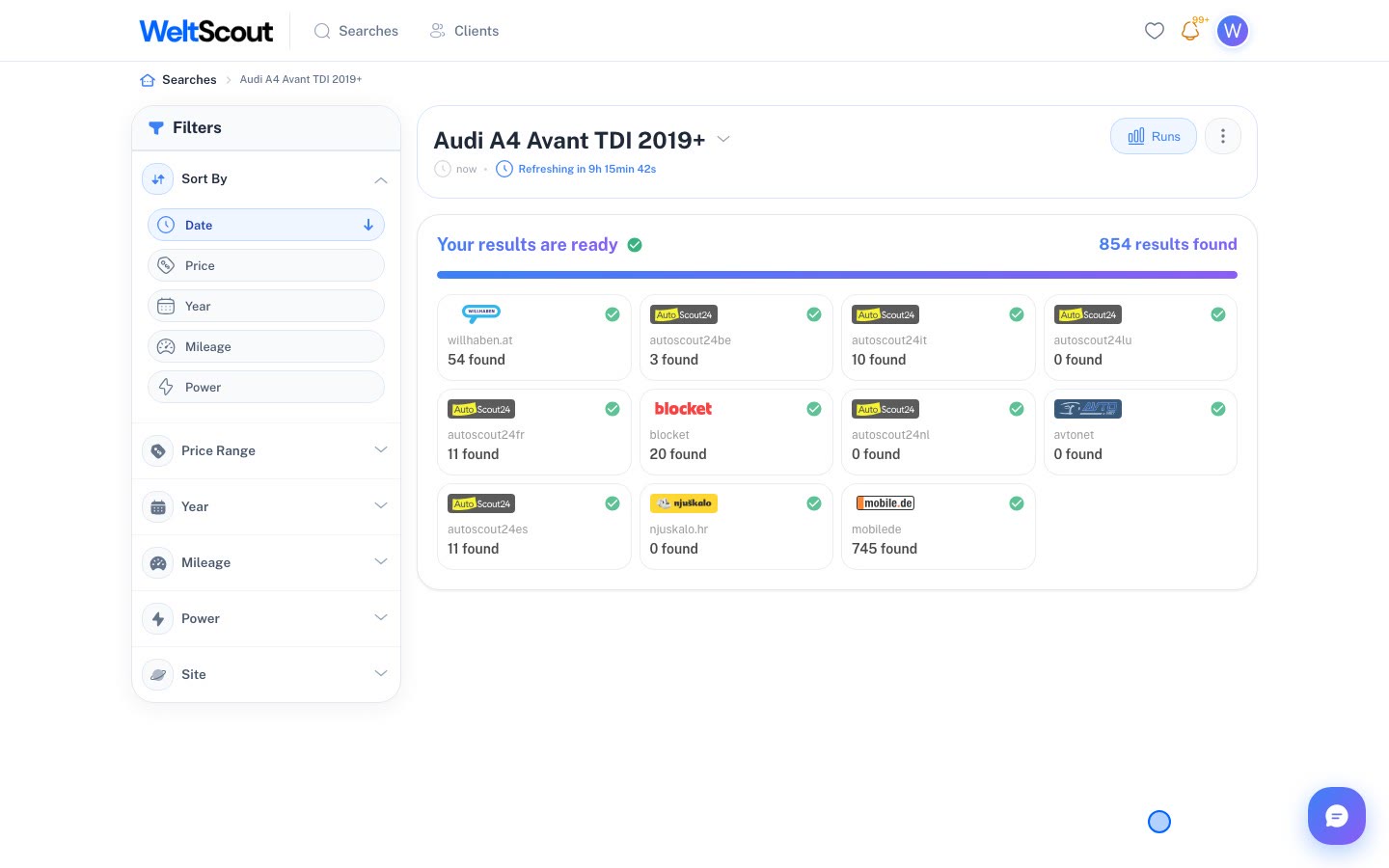
One search for the Audi A4 Avant on 11 portals in 11 countries: 854 matches, the count per portal, four example prices and the limits of the data. As of 27.10.2026.
For dealers and buyers5 min read
Buy a used car from Germany and import it to Slovenia: tax, plates, registration
What you pay and which papers you need to bring a used car from Germany to Slovenia: VAT, DMV, plates, conformity and registration. Sources read 28 October 2026.