For dealers6 min read
Used car sourcing for dealers: channels, process and tracking
- Author
- Luka Velkavrh
- Edited by
- WeltScout editorial team
- Published
- Updated

In short
Dealers source used cars in two ways: stock they buy at their own risk, and a car bought to a customer's brief. The process is the same for both: criteria, search across several sources, a quick margin check, verification, and only then the purchase. This guide is for dealers and brokers. As of October 2026.
Contents
- Two kinds of sourcing: stock and customer brief
- Sourcing channels and when each fits
- The sourcing process, step by step
- VAT when buying a used car in another EU country
- Sourcing metrics worth tracking
- Where WeltScout fits
- Official sources
- What this means for a dealer
- Frequently asked questions
- Sources
- Updates
Two kinds of sourcing: stock and customer brief
You buy stock because you expect to sell it, and a car to a brief because a customer has already asked for it. The difference shows up in your criteria and in your risk.
| Stock | To a customer's brief | |
|---|---|---|
| Who sets the criteria | You, from demand and your own sales | The customer; you write them down and confirm |
| Main risk | The car stays unsold | The customer drops out or buys elsewhere during the search |
| What makes it easier | A saved search for the models that sell for you | A written brief and a separate search for each customer |
The second kind is what many people call vehicle sourcing, and it is the same work in practice: finding, checking, buying and handing over a car that matches the customer's criteria.
Sourcing channels and when each fits
No channel is always best, so dealers usually combine several.
| Channel | When it fits | Watch out for |
|---|---|---|
| Listing portals at home and abroad | Hunting for a specific model or comparing markets | A lot of manual work if you follow each one separately |
| Other dealers and wholesale | When you need several cars at once | Terms and margin are a matter of negotiation |
| Trade-ins | A steady source for the local market | Valuation and the amount of preparation |
| Auctions and closed dealer marketplaces | Larger volumes, standard descriptions | The seller's rules and the cost of the process |
| Private sellers | Individual good-value cars | Tax treatment and document checks |
The sourcing process, step by step
The process pays off when you run every offer through the same steps in the same order.
| Step | The question you answer | What you end up with |
|---|---|---|
| 1. Criteria | Which car are we looking for, and up to what price? | A written brief or a stock profile |
| 2. Search | Where can we find it? | Searches with alerts, by source |
| 3. Quick margin check | Does it still work after the purchase price, transport, taxes and preparation? | A maximum purchase price |
| 4. Verification | Does the ad match the car? | Chassis number, history, inspection |
| 5. Tax treatment | Does the seller charge VAT under the standard rules or on the margin? | An invoice with the right notes |
| 6. Purchase and transport | Who moves the car and at whose cost? | Contract, handover, documents |
| 7. Record | Which source did it come from and how did it turn out? | A row in your sourcing sheet |
VAT when buying a used car in another EU country
Whether you pay VAT when buying in another EU country depends on how the seller accounts for it, so check the invoice before you commit. Your Europe, which we read on 19 October 2026, says that when you buy a used car from a dealer, the VAT may or may not be charged and mentioned separately on the invoice, depending on how the dealer opts to calculate VAT on that car.
Your own VAT and registration duties depend on the country where you are established, and the rules for traders differ from those for private buyers. Check the guidance of your national tax authority or ask a tax adviser before the first cross-border purchase. We do not give tax amounts here. The official starting point is Value added tax (VAT) when buying or selling a car abroad.
Sourcing metrics worth tracking
You improve sourcing when you measure which source gives you the best deals. Track the metrics by source.
| Metric | How to track it | What it shows |
|---|---|---|
| Time to shortlist | From the request to the first confirmed offer | How fast the search is |
| Viewed versus bought | Viewings and purchases per source | The quality of each source |
| Margin by source | Sale price minus all sourcing costs | Where sourcing really pays |
| Days in stock | From purchase to sale, by source | Which cars sit |
| Reasons for rejection | One tag per rejected offer | Where your criteria are too loose |
Where WeltScout fits
WeltScout covers the search through listings: 50+ portals in 14 countries in one list, with alerts about new listings on WhatsApp or by e-mail. Each customer gets their own search, and in the Clients module you save a name, phone number and e-mail and link searches to them. You can also set up a search for your own stock, with no customer attached. We check for new listings once or twice a day, depending on the plan. If a portal is missing, you can suggest it, and we usually add it within four to seven working days.
What WeltScout does not do: it does not inspect cars, buy for you or arrange transport. You handle those steps yourself or with partners. Pricing is per user, the Business plan starts at 129.90 EUR a month excluding VAT, and the trial needs no card. See the home page.
Official sources
Check tax details with official sources, which we read on 19 October 2026. The EU-wide rules on VAT for cars bought abroad are on Your Europe. For national rules on registration and vehicle taxes, use the tax and registration authority of the country where you will register or resell the car.
What this means for a dealer
- Write down the maximum purchase price for each car before you start searching.
- For every foreign offer, check the seller's tax treatment on the invoice before you buy.
- Record the source and outcome of every purchase, so in a few months you know which channel pays.
- If you search for several customers at once, keep a separate search for each, so none is neglected.
Frequently asked questions
What is vehicle sourcing?
It is finding, checking and buying a car that matches a customer's criteria, usually for an agreed fee. Write down the criteria and the scope of the service before you start searching.
Is VAT always charged when buying a used car in the EU?
No. Your Europe says it depends on how the dealer opts to calculate VAT on the car, so it may or may not appear separately on the invoice.
Does WeltScout buy the car for me?
No. WeltScout searches listings and alerts you to new ones. Checking, buying and transport stay with you.
How often are new listings checked?
Once or twice a day, depending on the plan.
Sources
- Value added tax (VAT) when buying or selling a car abroad Your Europe (European Commission),
Updates
- : Moved from the old site and rewritten to the new standard.
Searching several portals at once?
7 days freeNo card needed
Read next
For dealers and buyers7 min read
Buy a used car from Germany and import it to Serbia: customs, VAT, Euro 3
What you pay and which papers you need to bring a used car from Germany to Serbia: customs duty, VAT, Euro 3 and registration. Official sources read 28 October 2026.
For dealers5 min read
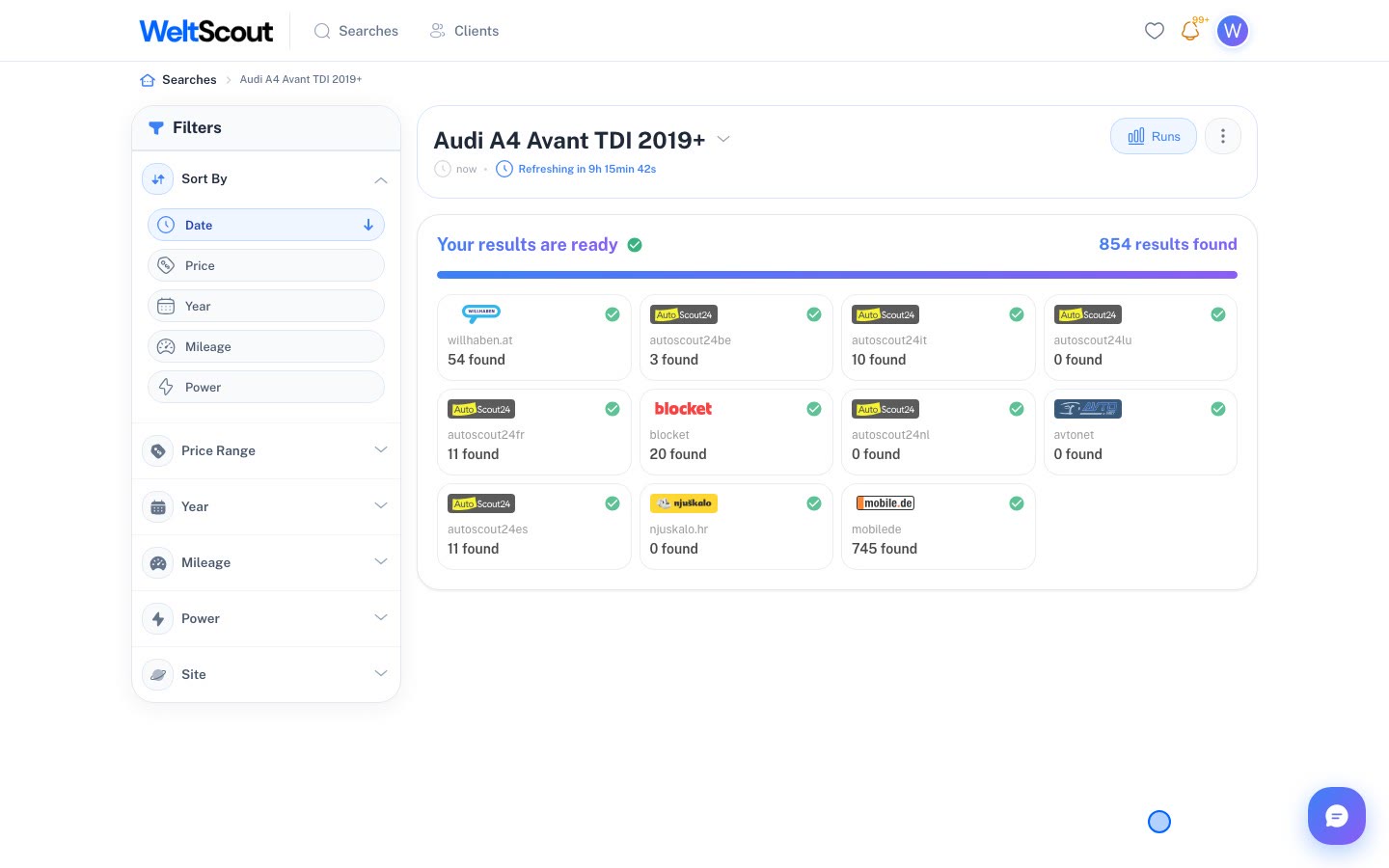
One search, 11 portals: what an Audi A4 Avant returns
One search for the Audi A4 Avant on 11 portals in 11 countries: 854 matches, the count per portal, four example prices and the limits of the data. As of 27.10.2026.
For dealers and buyers5 min read
Buy a used car from Germany and import it to Slovenia: tax, plates, registration
What you pay and which papers you need to bring a used car from Germany to Slovenia: VAT, DMV, plates, conformity and registration. Sources read 28 October 2026.